
Is 2.4 kg heavy for a wearable exoskeleton?
Not for a powered device worn at the waist. 2.4 kg is a little more than a 2-litre bottle of water, and on the ExoStride US-H-1.0Pro it rests on the pelvis rather than hanging from the shoulders or swinging at the ankle. Weight low on the leg costs much more energy to walk with than the same weight at the waist. The trade-off is that a lighter device usually means a smaller motor or battery, so total weight only makes sense next to torque and battery figures.
What 2.4 kg is, in everyday terms
2.4 kg is roughly a 2-litre bottle of water plus a mug, a medium bag of rice, or a laptop with its charger. Carried in your hand, you would notice it within a few minutes. Worn well, at the waist, most people stop noticing it once they are walking.
That difference between carrying and wearing is the whole story of exoskeleton weight.
Why where the weight sits matters more than how much
When you walk, your legs swing forward with every step. Anything attached low on the leg, such as a heavy shoe or an ankle weight, has to be accelerated and stopped with each stride. It is well established in walking research that added mass is more costly the further it sits from the body's centre, which is why runners care so much about shoe weight.
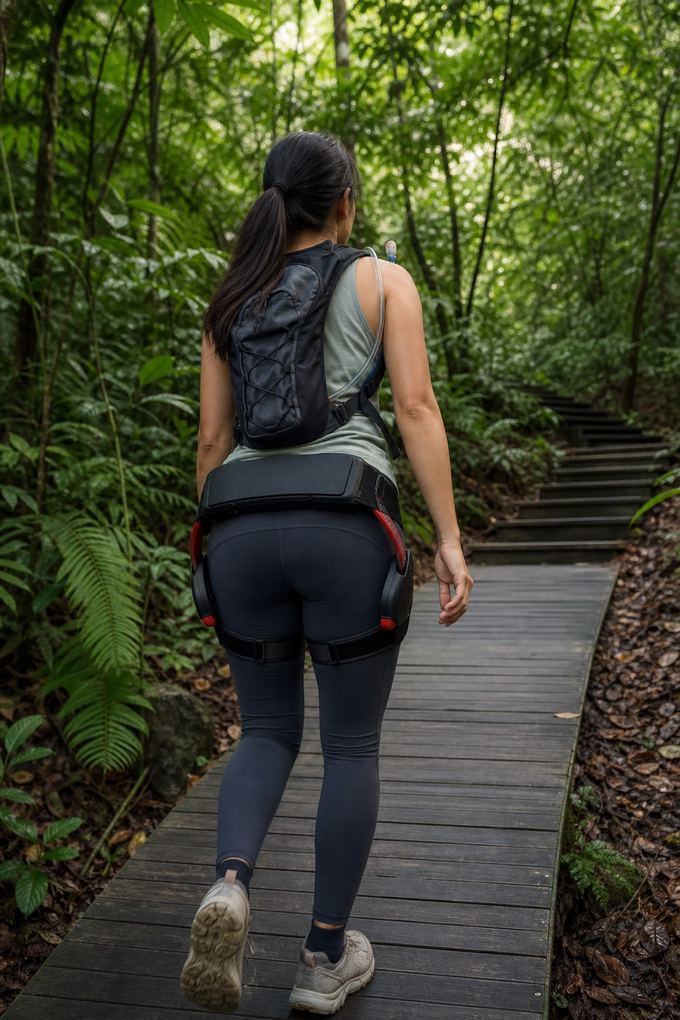
Weight at the waist, by contrast, moves with the body's centre of mass. It still has to be carried up stairs and slopes, but it does not have to be swung back and forth. That is why a hip-mounted device can weigh more than an ankle brace and still feel lighter in use.
- At the waist: carried by the pelvis, moves with the body, least costly.
- On the thigh: swung with each step, but close to the hip.
- At the knee or ankle: swung through the widest arc, most costly per gram.
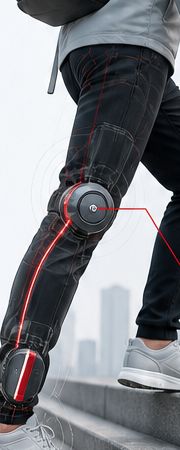
The US-H-1.0Pro puts its motors and battery at the hip, with only short links along the thigh.
Weight against what it does
Total weight is meaningless on its own. An unpowered brace can be very light because it has no motor or battery. A powered device must carry both. So compare weight together with:
- Peak torque: 16 Nm for the US-H-1.0Pro.
- Assistance time: up to 4 hours per charge.
- Charge time: 2 hours.
A device that is half the weight but delivers far less assistance or runs out after an hour is not lighter in any way that matters. Our spec-sheet guide shows how these lines relate.
What happens to the weight when you are being assisted
While the device is working, it adds assistance at the hip as each leg lifts. The manufacturer claims up to 80% less lower-body load per step for this model. Treat that as a manufacturer claim; your own result depends on you, the terrain and the assistance level. Practically, on stairs and slopes most users feel the assistance far more than the weight.
And when the battery runs out
This is the honest test of any powered device. When the US-H-1.0Pro's battery runs out, it stops assisting but does not lock the legs. You keep walking normally, carrying 2.4 kg at your waist. That is noticeable on a long climb but not a hazard. Planning a charge around longer days avoids it; our battery guide covers how.
Weight for older users
For an older person, weight matters at two moments: putting the device on and carrying it when it is off. Worn at the waist and put on seated, 2.4 kg is manageable for most people after a fitting. Folded, it can sit on a shelf by the door or go in a tote bag. If lifting even that is difficult, a family member can help with putting it on. Our guide to putting it on seated explains the routine.
Weight for hikers and commuters
For a commuter, the question is whether it fits in a bag at the office: folded, it does. For a hiker, it is the trade between carrying 2.4 kg and having assistance on the climbs. Our trekking poles comparison looks at where those grams are earned back.
How to judge it yourself
Spec sheets cannot tell you how weight feels. At a fitting, walk the same short stretch twice: once with the device switched off, once switched on. The first tells you what the weight feels like; the second tells you whether the assistance outweighs it on your route.