Are trekking poles or a powered exoskeleton better for climbing?
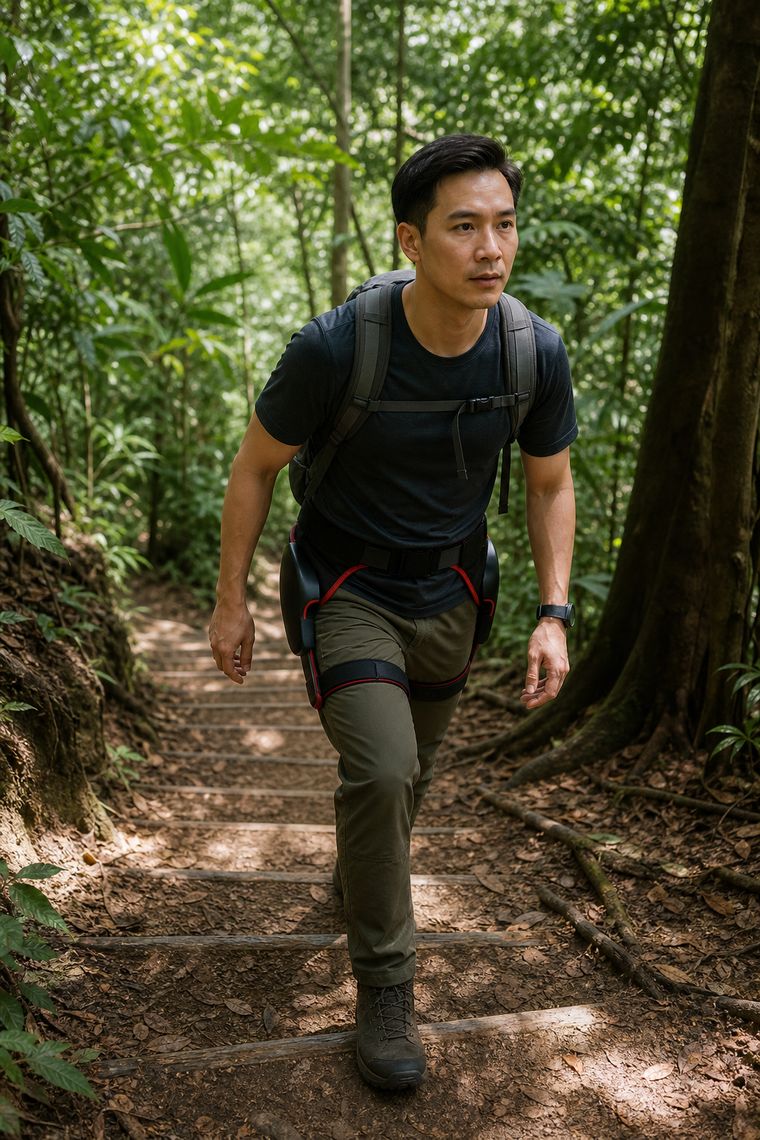
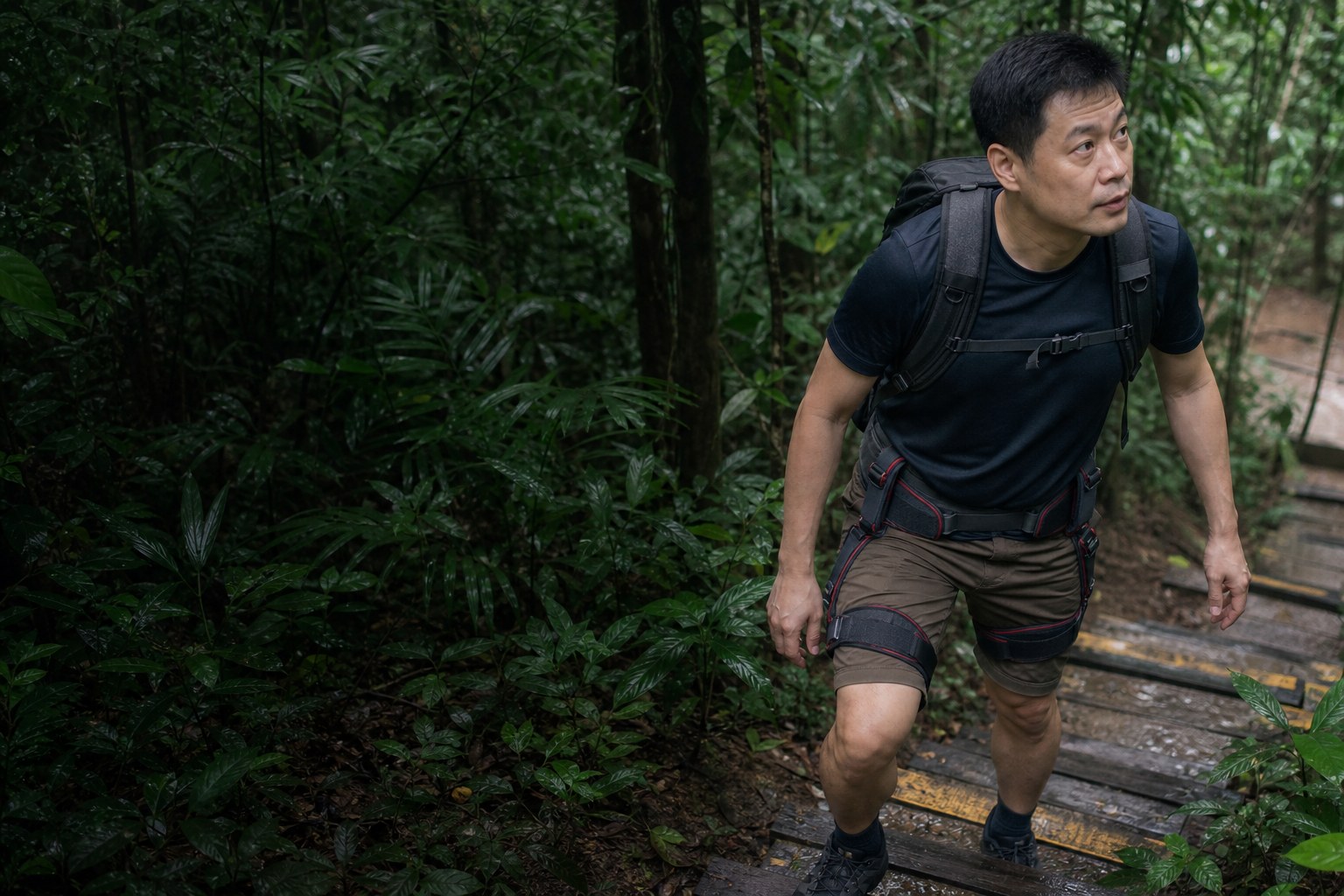
They do different jobs. Poles add balance and take load off the knees on descent, at the cost of occupying both hands and adding arm fatigue on long ascents. A powered hip exoskeleton adds up to 16 Nm at the hip flexors — the muscles that actually drive a climb — cutting climbing energy by up to 35% and extending range 2–3x. For a single easy trail, poles are enough. For sustained ascents, repeat training or a return to the trail after injury, the hip assist compounds.
The category oversells the summit and undersells the arithmetic
Almost half of everything published about consumer exoskeletons is adventure imagery — the silhouette on the ridgeline. It is also, measurably, the least persuasive material in the category. What hikers actually want to know is arithmetic: how much energy, over what gradient, for what added weight. So here it is.
Where each one intervenes
The honest split:
- Poles — excellent for balance, stream crossings and knee load on descent. They shift effort to shoulders and arms; on a long ascent that is a transfer, not a saving.
- Powered hips — up to 16 Nm delivered inside the flexion window of each stride, targeting the muscles doing the climbing. Up to 35% less climbing energy, 2–3x the range.
- Both together — common. Poles for the descent and the scrambles, hip assist for the ascent.
Where it earns its 2.4 kg
Any worn device has to pay for its own weight before it saves you anything. On a flat 3 km boardwalk it roughly breaks even. On sustained gradient — a Bukit Timah summit repeat, a Southern Ridges traverse with the bridge climbs, or a training block for an overseas ascent — the saving compounds every step and the 2.4 kg stops being the conversation.
Tropical trails are a sealing problem, not a power problem
Local trails are humid, dusty and prone to sudden rain. IP54 covers dust ingress and splashing water from any direction, which is the actual failure mode on a MacRitchie boardwalk in the afternoon — not torque, not battery.