How much torque does a powered hip exoskeleton need?
Torque is rotational force at the joint. At the hip, 16 Nm is roughly the assistance of a firm, well-timed push at the thigh on every stride. It is not enough to move a leg that cannot move — and it is not meant to be. It is enough to remove the peak cost of a step, which is where a stair, a slope or the fourth kilometre actually hurts. Peak numbers matter far less than timing: assistance delivered at the wrong moment is dead weight.
What a newton-metre is, without the physics lecture
One newton-metre is the twist you get from pressing with about 1 kg of force at the end of a 10 cm lever. Sixteen of them, applied at the hip joint, is comparable to a steady hand pushing your thigh forward and up at the exact instant your leg starts to swing. You still do the walking. The assistance shaves the top off the hardest part.
Why the hip, and not the knee
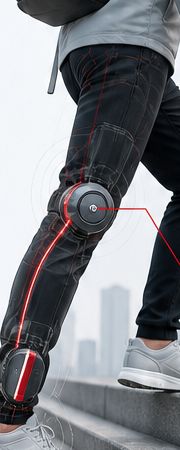
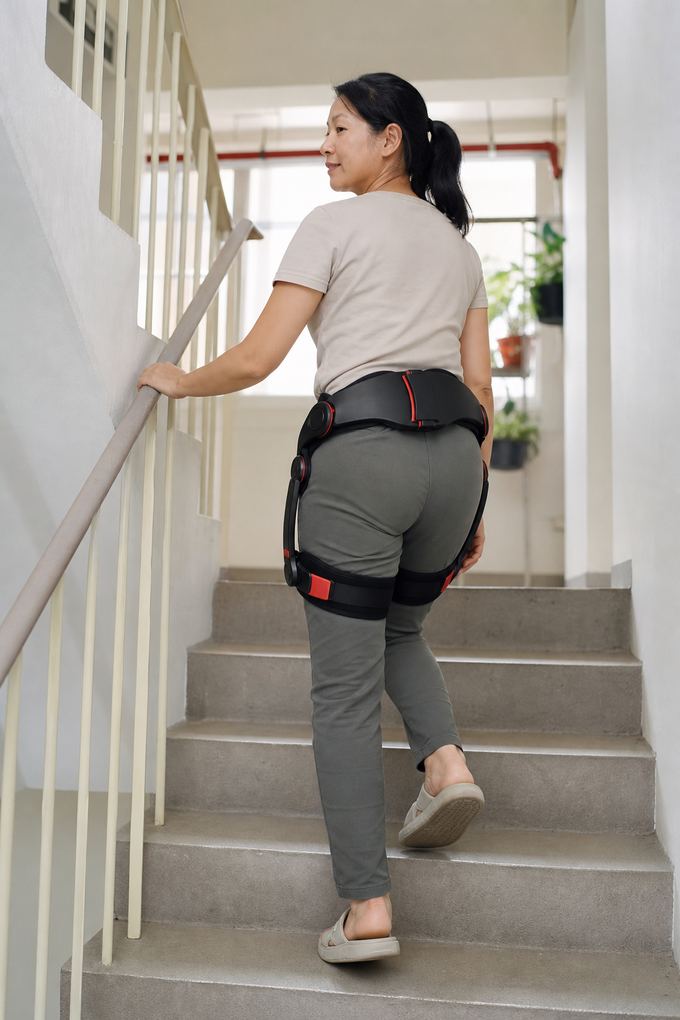
On stairs and inclines, the hip flexors do the expensive work of lifting the whole leg against gravity; the knee mostly manages the landing. Assisting the hip therefore buys more per newton-metre and per gram of hardware, which is how the whole unit stays at 2.4 kg. It also leaves the knee's natural shock absorption untouched.
Timing beats peak numbers
This is the part the spec sheets never cover. A higher peak torque delivered 100 milliseconds late feels like a shove, fights your stride and gets switched off within a week. The US-H-1.0Pro reads gait continuously and releases torque inside the flexion window, and it shifts profile automatically between level ground, stairs and steep terrain. That is why there is nothing to adjust while walking.
What it adds up to
Measured across the three use cases ExoStride is built for:
- Rehabilitation — up to 80% less lower-body pressure per step.
- Climbs — up to 35% less energy on steep, sustained ascents.
- Daily commute — 30–50% less exertion across a normal day.