Can a powered exoskeleton help with climbing stairs?
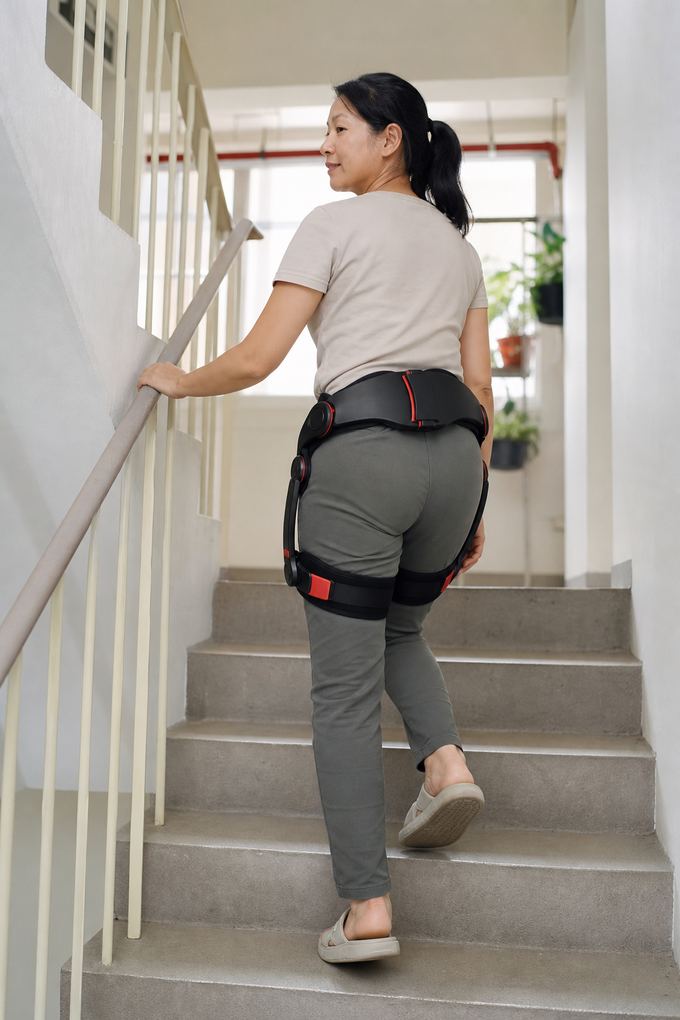
Yes — stairs are the single clearest case for hip assistance. Climbing a step means lifting your whole body mass against gravity using the hip flexors, which is why stairs cost several times what flat ground costs. The US-H-1.0Pro detects the change in terrain and raises its assistance profile automatically, delivering up to 16 Nm at the moment of lift. Both hands stay free for the handrail.
Why stairs cost so much more than they look
On flat ground, walking is mostly a controlled fall forward — gravity does a share of the work. On a staircase, none of it is free. Every step raises your entire body mass by 15–18 cm, and the hip flexors carry that lift. This is why a two-flight climb can end a walk that a kilometre of flat pavement would not have.
The three staircases that matter in Singapore
The routes people actually give up first:
- Station stairs — Dhoby Ghaut, Bras Basah, Bencoolen and every deep interchange where the escalator queue is longer than the climb.
- Overhead bridges — unavoidable, unsheltered, and the reason many shorter routes get abandoned entirely.
- The walk up to the flat — the last flight, at the end of the day, carrying something.
What the exoskeleton actually does on a step
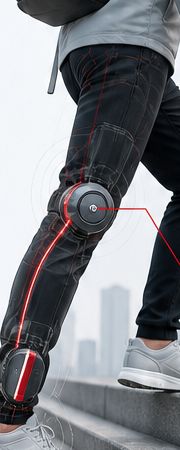
Sensors read the gait change as the leg begins a higher swing and the controller shifts to the stair profile — more torque, delivered earlier in the flexion window. Coming down, assistance eases so it does not push you into the descent. There is no stair button and nothing to switch. Both hands stay free, which matters more than any specification: the handrail is still the best safety device on a staircase.