
How should a hip exoskeleton fit?
Snug, low and aligned. The belt should sit low on the pelvis, not on the soft waist or the ribs, firm enough not to slide but loose enough to breathe and sit comfortably. The device's hip joints should line up with your own hip joints at the side. Thigh straps should hold the links against the outside of each thigh with room for two fingers underneath. A good fit is what turns torque into useful assistance; a poor fit wastes it and causes rubbing.
Why fit decides how well it works
A powered hip exoskeleton passes force from its motors to your legs through two contact points: the belt at the pelvis and the straps at the thighs. If those contact points move, slip or press in the wrong place, some of the assistance is lost as the device shifts instead of your leg moving. It can also feel as though the timing is off, when the real problem is fit.
That is why the Singapore team does a guided fitting before first use, and why it is worth knowing what a good fit looks like.
The belt: low and firm
- Position: on the bony part of the pelvis, around the top of the hips. Not on the soft waist, and nowhere near the ribs.
- Tightness: firm enough that it does not slide up when you walk or climb stairs, but you can breathe deeply and sit comfortably.
- Clothing: over a single layer is best. Thick waistbands, belts with large buckles and bulky pockets under the belt create pressure points.
If the belt rides up as you walk, it is usually too loose or sitting too high to begin with.
The hip joints: aligned with yours
The device has a joint at each side of the hip. For the assistance to feel natural, those joints should sit level with your own hip joints, roughly at the side of the hip where the thigh bone meets the pelvis. If they sit too high or too low, the thigh link moves in a slightly different arc from your thigh, which can rub and make the push feel awkward.
The thigh straps: secure, not tight
- Position: on the outside of the thigh, above the knee, with the link lying flat along the leg.
- Tightness: two fingers should slide underneath. Too tight restricts circulation and leaves marks; too loose lets the link rotate.
- Check: when you walk, the link should stay on the outside of the thigh rather than drifting to the front.
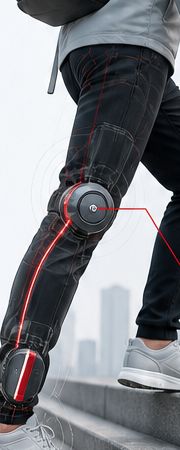
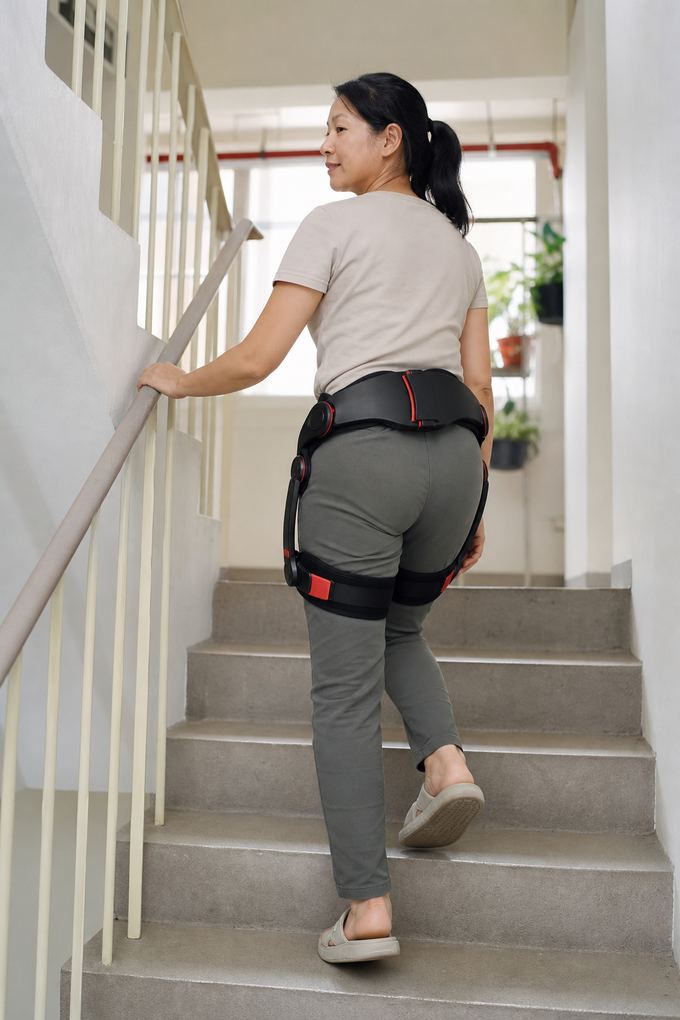
What a good fit feels like
- After a few minutes of walking, you stop noticing the belt.
- On stairs, the assistance feels like a nudge at the thigh rather than a tug at the waist.
- Sitting down is comfortable without loosening anything.
- After taking it off, any marks fade within a few minutes.
Our 16 Nm explainer describes what well-timed assistance should feel like once the fit is right.
Signs the fit needs adjusting
- Red marks or sore spots that last more than twenty minutes after taking it off.
- The belt sliding up, or pressing into the lower back.
- Thigh links rotating to the front or back of the leg.
- Rubbing at the side of the hip.
- Assistance that feels like a shove or a tug rather than a nudge.
Do not put up with any of these. Contact the team; most are fixed by small adjustments.
Sizing before you book
Fit depends on waist, hip and thigh measurements and on the configuration supplied in Singapore. Before booking a fitting, it helps to have a rough idea of your measurements and to ask the team whether they fall in the device's range. The fitting confirms it.
Fit for older users and limited mobility
For older users, the priority is a fit that can be repeated every day without help. The team can set strap lengths so that daily use is mostly fastening rather than adjusting. Our step-by-step guide to putting it on seated is built around this.
Fit and weight
A good fit also changes how heavy the device feels. 2.4 kg resting firmly on the pelvis feels very different from 2.4 kg sliding around. Our guide to exoskeleton weight covers where weight should sit.
Sharing a device
The belt and thigh links adjust, so two people can physically share a unit. In practice, sizing has to be readjusted with each swap, which adds friction. If two people in a household would use it daily, raise it at the fitting.