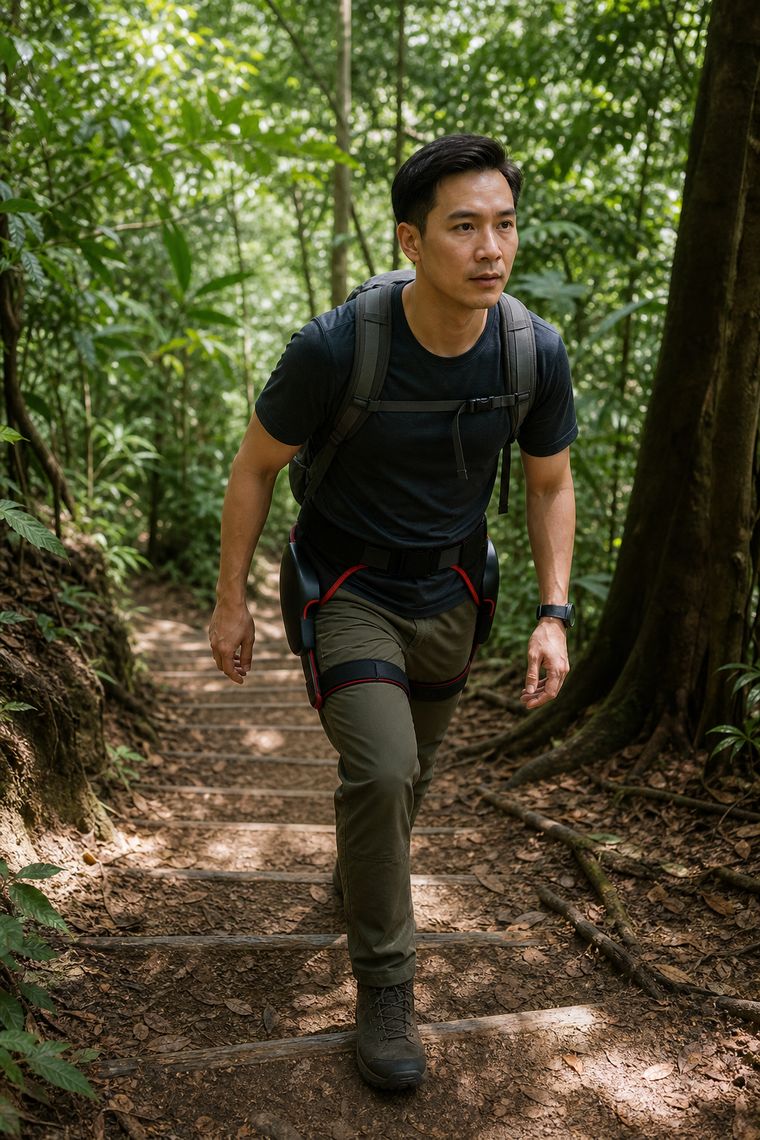
Does a powered hip exoskeleton help on steep slopes and ramps?
Yes, going up. Climbing a slope means lifting your body with every step, and the hip does much of that work, so hip assistance is most noticeable on inclines. The ExoStride US-H-1.0Pro detects steep terrain and increases assistance automatically; the manufacturer claims up to 35% less energy on steep, sustained climbs. Going down, it reduces assistance so it never pushes you forward, because descent is about control and grip, not power. Shorter steps, a steady pace and good shoes still matter most.
Why slopes are underestimated
Stairs announce themselves. Slopes do not. A long ramp up to a station entrance, the road up to a hilltop estate, the path from the bus stop to a hospital on a hill or the incline at the end of a park walk can be just as tiring as a staircase, and they often go on longer. People who avoid stairs often find they have quietly started avoiding certain slopes too.
What a slope does to each step
On level ground, much of walking is about moving forward. On an incline, every step also has to raise your body a little. That extra work falls largely on the muscles that lift the leg and drive the body up: the hip flexors as the leg swings forward, and the hip and thigh muscles as you push up. The steeper the slope, the bigger the share of effort that goes into lifting.
That is why your breathing changes on a hill even at a slow pace, and why the same distance feels much longer uphill.
How to walk uphill with less effort
- Shorten your steps. Short steps keep each lift small.
- Keep a steady pace you could talk at; slow down before the slope rather than halfway up.
- Lean slightly forward from the ankles, not the waist.
- Use the handrail on ramps where there is one.
- Rest briefly at flat sections or landings rather than stopping on the steepest part.
How to walk downhill safely
Going down is less tiring but riskier. The legs work as brakes, and wet surfaces add to the slip risk.
- Take shorter steps and slow down.
- Keep your knees slightly bent.
- Use the handrail on ramps.
- Wear shoes with good grip, especially after rain.
What a powered hip exoskeleton changes uphill
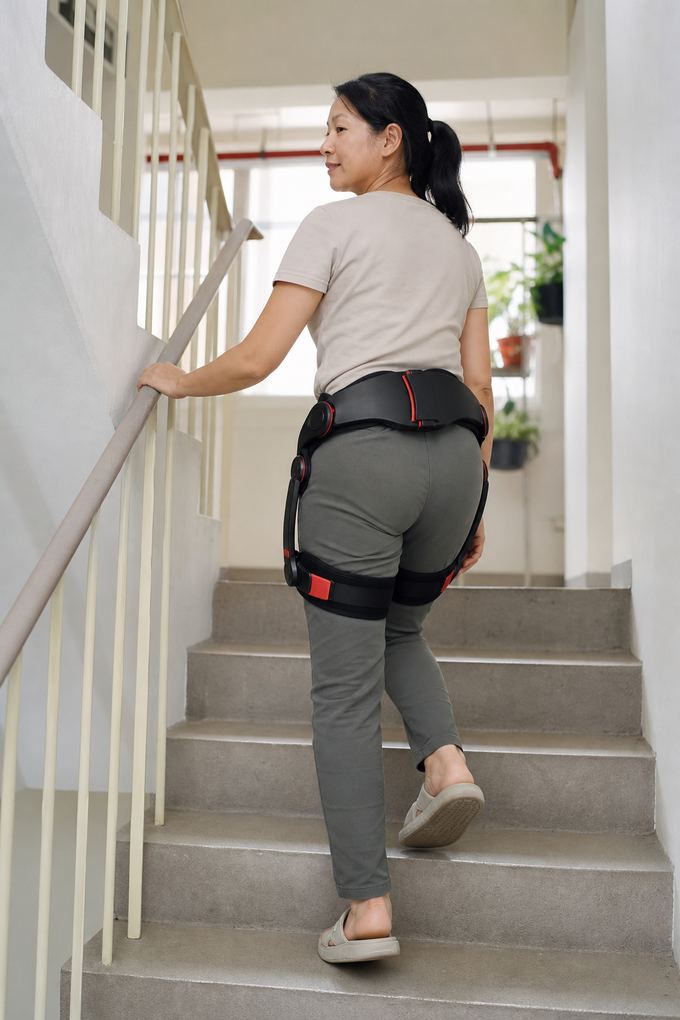
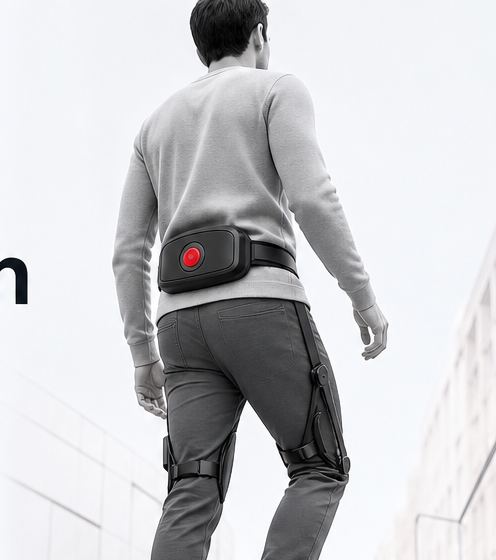
The ExoStride US-H-1.0Pro reads your gait continuously and recognises when the terrain gets steep. On an incline it increases assistance at the hip as each leg lifts, with a peak of 16 Nm (spec-sheet figure). For steep, sustained climbs, the manufacturer claims up to 35% less energy, and up to 80% less lower-body load per step overall. Those are manufacturer claims, and the effect depends on the slope, your pace and your fitness.
In practice, users notice it most on long ramps and steep roads, where the cumulative effort matters. Our guide to how exoskeletons sense gait explains how the switch between flat and steep profiles happens without any button.
What it does downhill
On descent, the US-H-1.0Pro reduces assistance so that it never pushes you forward. Going downhill is a control problem rather than a power problem, and extra forward push would be the wrong kind of help. It does not provide braking or grip. Your shoes, your pace and the handrail are what keep you safe on the way down.
Slopes versus stairs
Stairs concentrate the lift into high, regular steps; slopes spread it over distance. A powered hip device helps with both. Our stairs guide covers MRT stations, overhead bridges and HDB blocks, and our guide to when the HDB lift is down covers long stair climbs.
Battery on hilly routes
Climbing draws more power than flat walking. The spec sheet gives up to 4 hours of assistance per charge; a route with a lot of uphill will use it faster. Charge it fully before a hilly day.
Wet slopes
The US-H-1.0Pro is IP54-rated, so rain is not a problem for the device. It is a problem for grip. Slow down and use handrails on wet ramps, and avoid steep, slippery paths after heavy rain.
Find the slopes on your routes
Many people do not realise how many slopes they avoid. Take a week and note every route you skip or shorten because of a hill or a long ramp: the road up to a friend's estate, the path to a hilltop clinic, the ramp at a station entrance. Those are the routes to test first. A fitting on your own route lets you feel the difference on the slope that actually matters to you, rather than on a demonstration ramp.