How do I choose a powered exoskeleton for an elderly parent?
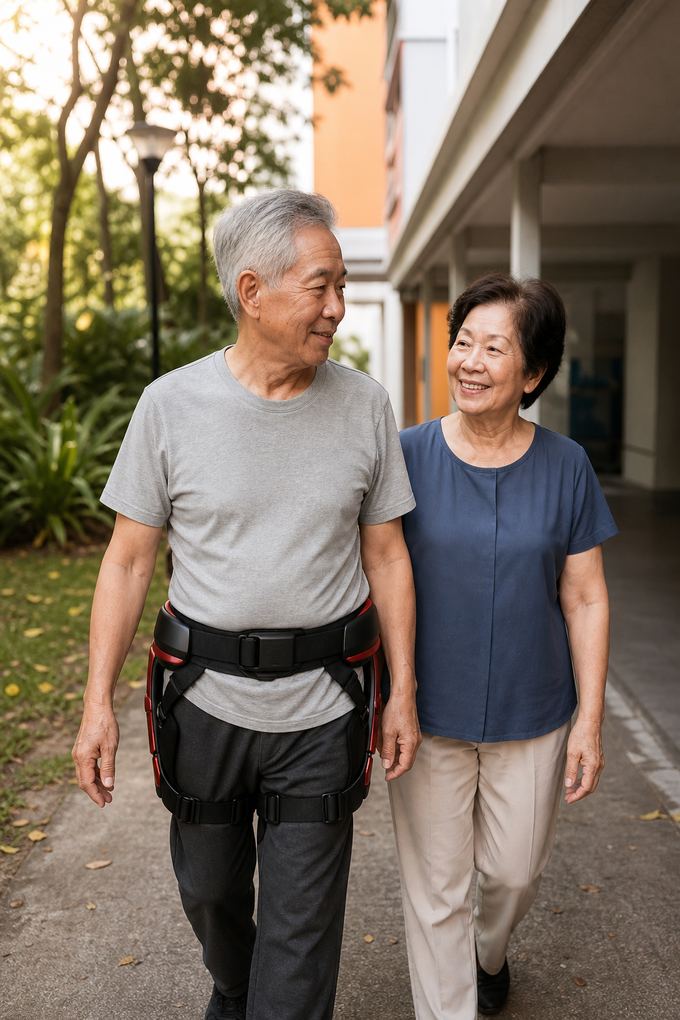
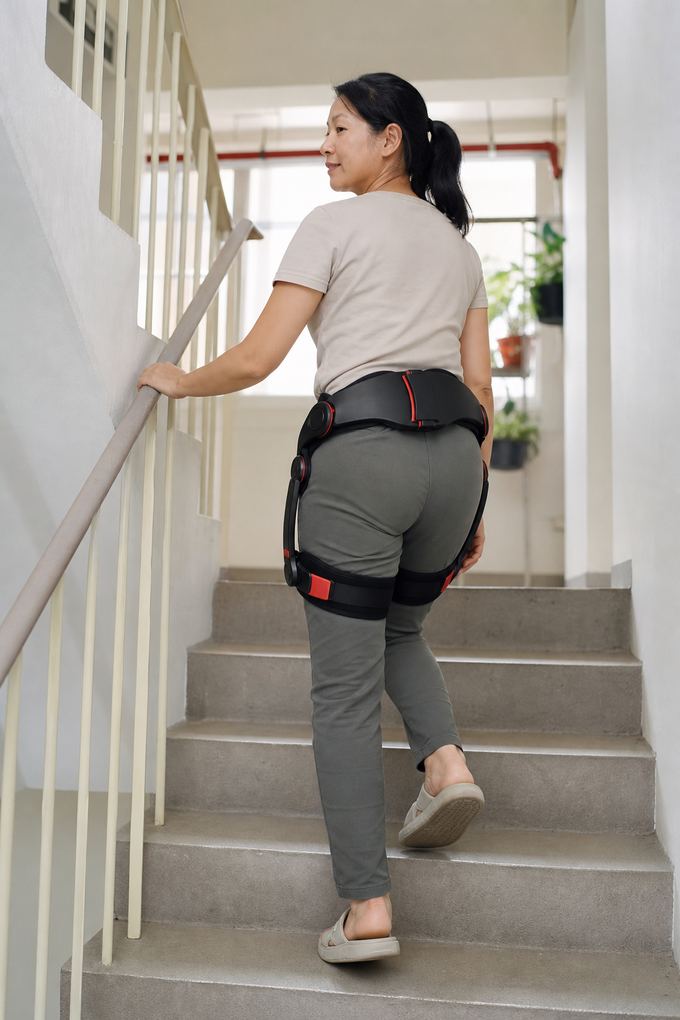
Check five things, in this order: (1) where they actually struggle — stairs, distance or confidence; (2) total worn weight, because anything above roughly 3 kg gets left by the door; (3) whether assistance starts on one button with no app; (4) whether the assistance adapts to stairs automatically; and (5) whether you can book a supervised fitting in their own home rather than a showroom. ExoStride's US-H-1.0Pro is 2.4 kg, one-button, terrain-adaptive, and fitted at home in Singapore.
Start with the route, not the product
Before comparing any specification, name the specific journey that is being lost. "Mum is slower" is not actionable. "Mum has stopped going to the market on Saturday because of the overhead bridge" is. The route tells you which capability matters, and it is also the only honest way to judge, three weeks later, whether the thing worked.
The five checks
In practice these separate a device that gets worn from one that gets stored:
- Worn weight. Above ~3 kg, compliance drops sharply. US-H-1.0Pro is 2.4 kg, carried on the pelvis.
- Time to start. One button beats any app. If it needs a phone, it will not be used on a Tuesday morning.
- Stair behaviour. Ask to see it on an actual staircase, not a showroom ramp.
- Battery honesty. 4 hours of assistance and a 2-hour recharge should cover a full day of errands with margin.
- Where the fitting happens. A home fitting on their own stairs is worth more than any brochure.
How to raise it without it landing as an insult
This is the part most guides skip, and it is the part that decides the outcome. A mobility aid offered as a concession to decline gets refused. The same device offered as a way to get a specific thing back is usually accepted. Lead with the route — the market, the grandchild's school gate, the temple stairs — and let the hardware be the boring means to it. Ask them to try it once, on their own route, with no commitment.