
How do you know if a powered exoskeleton is actually helping?
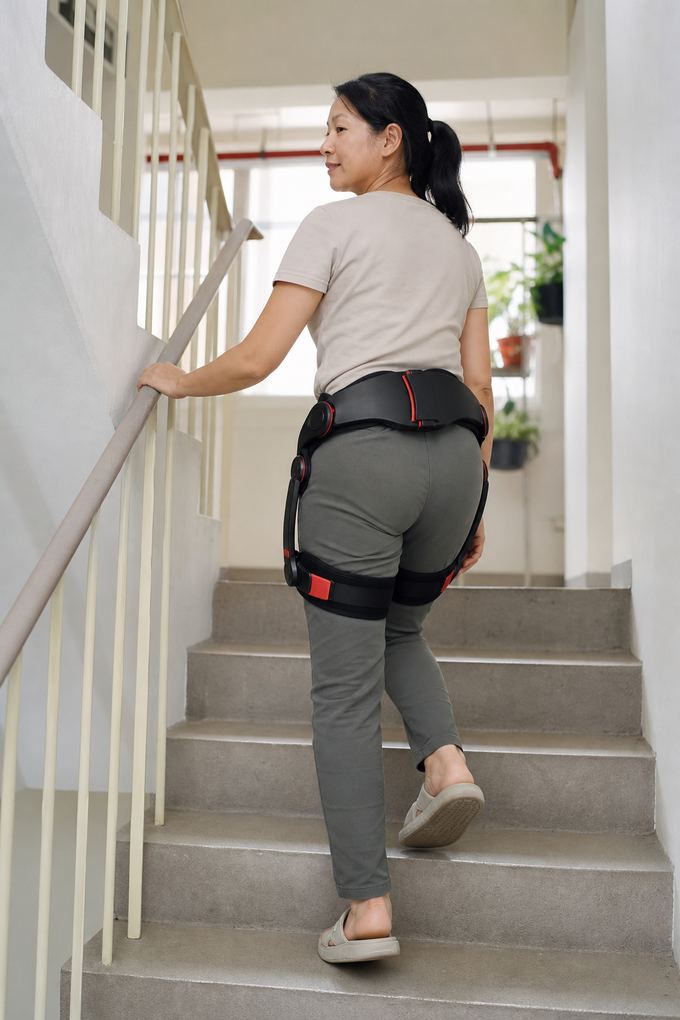
Track the same few things before and after: one route you care about, how far you walked, how many times you stopped to rest, how many flights of stairs you managed, and how tired you felt afterwards on a 0 to 10 scale. Write them down for a week without the device, then for four weeks with it. If the route gets easier, longer or more frequent, it is helping you. If nothing changes after a month, talk to the team and your physiotherapist rather than persisting.
Why your own numbers matter more than ours
Every exoskeleton brand publishes performance figures. For the ExoStride US-H-1.0Pro, the manufacturer claims up to 80% less lower-body load per step, up to 35% less energy on climbs and two to three times the walking range. Those are manufacturer claims, measured under the manufacturer's conditions. They are a reason to try the device, not a prediction of what it will do for you.
What actually matters is simple: does the person walk more, more comfortably, on the routes they care about? You can answer that without any equipment, as long as you write things down.
The five things to record
Use a notebook, a calendar on the fridge or a note on a phone. After each walk, record:
- The route: the same named route each time, such as "home to market and back".
- Distance or time: either works, as long as you are consistent. A phone step counter is fine if you already use one.
- Rest stops: how many times you stopped to sit or lean.
- Stairs: how many flights climbed without stopping.
- Effort: how tiring it felt afterwards, on a scale from 0 (no effort) to 10 (the hardest possible).
Add one line of comments if something stood out, such as "very hot", "slept badly" or "walked with a friend".
First, a baseline week without the device
If you can, record a normal week before the device arrives. Without a baseline, it is hard to tell whether a good day is down to the assistance or the weather. If a week is not possible, record two or three walks of the main route, unassisted, with someone alongside.
The first four weeks
Keep the route the same for the first fortnight so the comparison is fair. A sensible pattern, which the fitting team will adjust to the person:
- Week 1: get used to the feel. Expect your records to be similar to the baseline, or a little better.
- Week 2: the same route, with the assistance level the fitting team set. This is where changes in rest stops and effort usually show.
- Weeks 3 and 4: extend the route by one stretch, or add a route that had been given up.

What progress looks like
Progress is not always a bigger number. Any of these is a good sign:
- Fewer rest stops on the same route.
- A lower effort score for the same walk.
- The same walk done on more days of the week.
- A route that had been given up, done again.
- Less tiredness the evening after a walk.
If the effort score drops but distance does not change, that still counts. Many people care more about arriving home with energy left than about walking further.
When to adjust, and when to stop
- If effort scores go up, or new aches appear, stop and contact the team. Fit and assistance level can often be adjusted.
- If nothing changes after four weeks of regular use, raise it honestly with the team and with a physiotherapist. The device may not suit the problem. Our guide to who a hip exoskeleton is not for covers the common reasons.
- If there is pain, dizziness, a fall or a near-fall, stop and see a doctor.
Share the log
A written log is the most useful thing to bring to a physiotherapy appointment. It turns "I think it's better" into evidence. Our guide for physiotherapists suggests how the treating physio can set the target route. And if you want to understand how researchers measure the same things in a lab, see our guide to judging exoskeleton performance claims.
A sample week of entries
- Mon: home to market and back, 25 min, 2 rest stops, 1 flight, effort 6.
- Wed: same route, 24 min, 2 rest stops, 1 flight, effort 5, hot.
- Fri: same route, 23 min, 1 rest stop, 2 flights, effort 5.
- Sun: park loop with family, 35 min, 2 rest stops, 0 flights, effort 4.
Four lines a week is enough to see a trend.