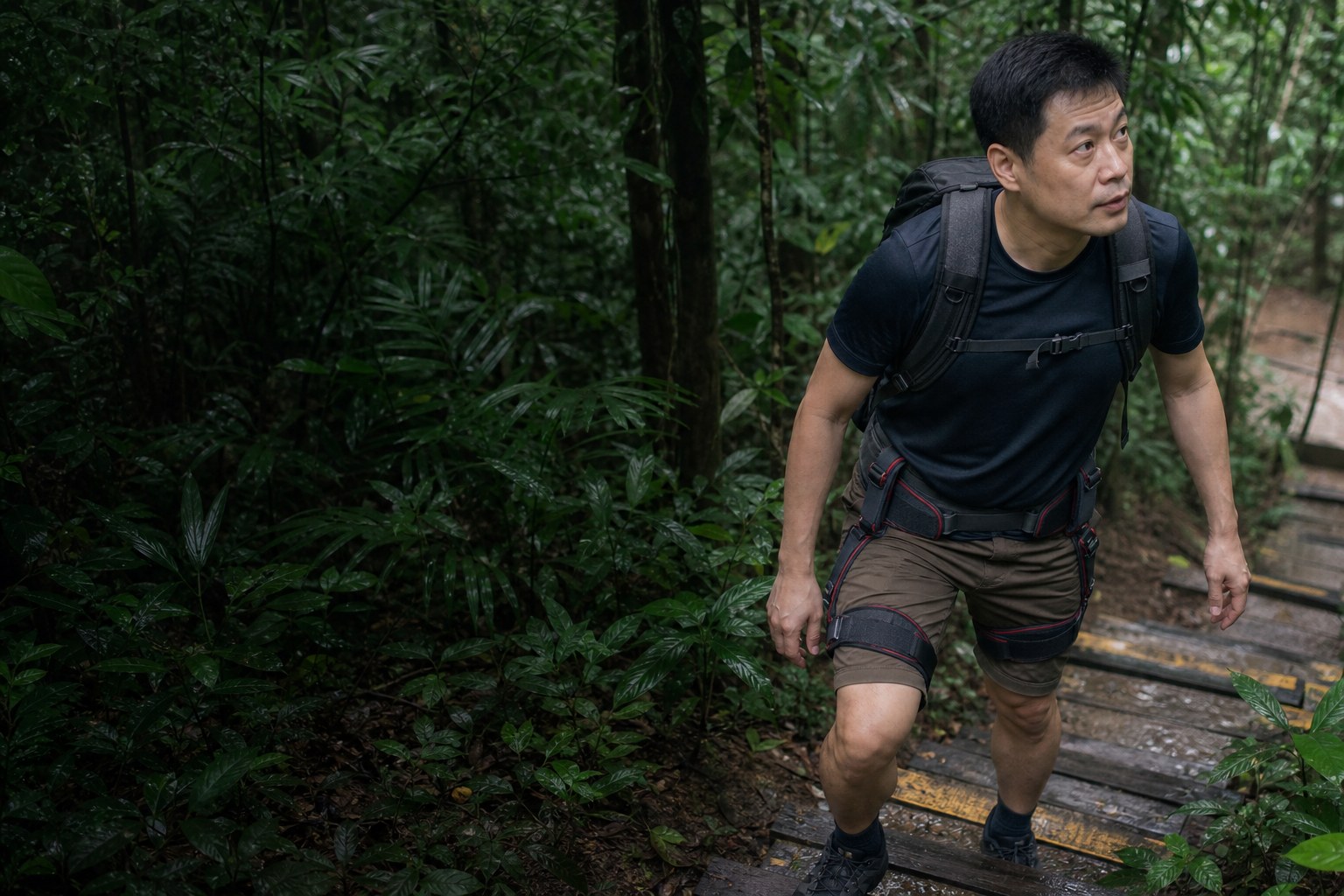
Should a hiker use a knee brace or a powered hip exoskeleton?
They solve different problems. A knee brace supports and stabilises the knee and is mainly about comfort, confidence and control, especially on descents. A powered hip exoskeleton adds energy at the hip as you lift each leg, which matters most on climbs. If your knee is the problem, start with a doctor or physiotherapist and the right brace. If your legs run out of energy on the ascent, hip assistance targets that. Many hikers who use a brace for the way down could add hip assist for the way up.
Two products that get compared because they sit on the leg
Hikers with tired or sore legs often end up asking the same question in a shop or online: should I get a knee brace or one of those powered exoskeletons? The comparison is natural because both are worn on the legs. But they act on different joints, in different ways, at different parts of the hike.
This guide is a measured comparison of what each actually changes. It is not medical advice. If your knee hurts, see a doctor or physiotherapist before choosing either.
What a knee brace does
Knee braces range from simple elastic sleeves to hinged braces with rigid supports. In general, they:
- Provide compression and warmth, which many people find comfortable.
- Add a sense of support and confidence, especially on uneven ground.
- In hinged designs, limit unwanted sideways movement or control how far the knee bends.
What a brace does not do is add energy. A brace cannot push you up a hill. Its main value is on the way down, on rough ground and for knee comfort, and the right type depends on the knee problem. That is a question for a clinician.
What powered hip assist does
A powered hip exoskeleton such as the ExoStride US-H-1.0Pro sits at the waist, with links along the outside of each thigh. It reads your gait and adds up to 16 Nm of torque at the hip as each leg lifts (spec-sheet figure), increasing automatically on steep terrain. It leaves the knee free.
- On climbs: it adds energy at the moment the hip lifts the leg. The manufacturer claims up to 35% less energy on steep, sustained ascents; that is a manufacturer claim, and results depend on the hiker and the trail.
- On descents: it reduces assistance so it never pushes you forward. It does not brace or protect the knee.
- On the flat: light assistance, adding up over distance.
Where each helps on a typical hike
- Steep ascent: brace offers little; hip assist offers the most.
- Long, steady climb: brace offers little; hip assist reduces accumulated fatigue.
- Steep descent: brace offers support and confidence; hip assist reduces assistance and offers little.
- Rough, uneven ground: brace offers stability for some knees; hip assist offers no stability.
- End of a long day: both can matter, for different reasons.

Weight and comfort
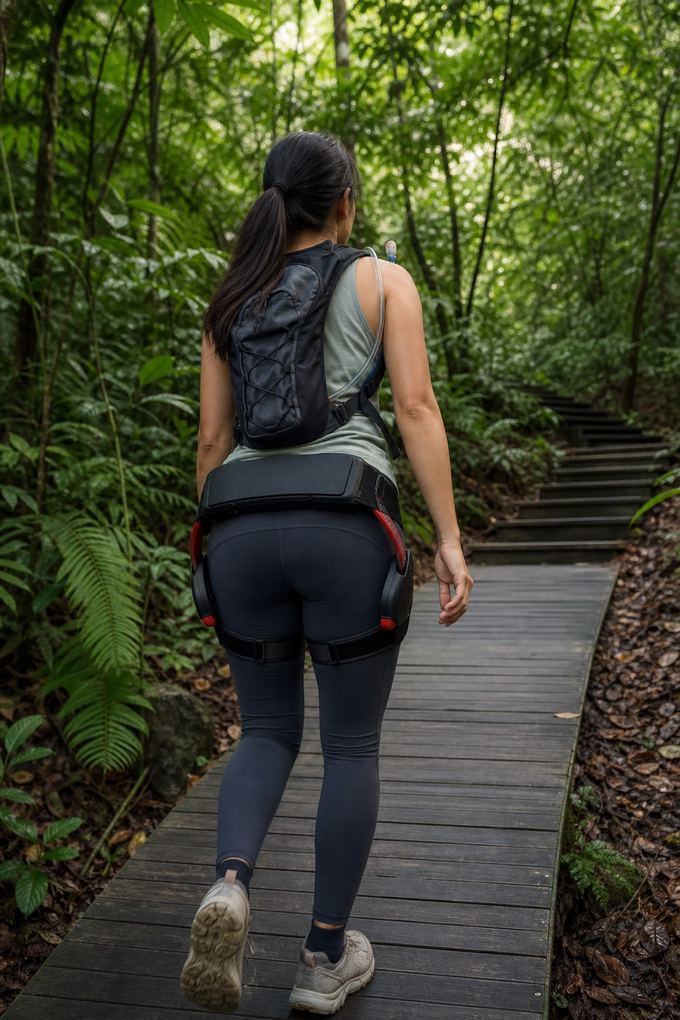
A knee sleeve weighs very little; a hinged brace more. Both sit mid-leg and are swung with every step. A hip exoskeleton weighs more in total, 2.4 kg for the US-H-1.0Pro, but sits at the waist, where weight costs less to carry. Our guide to hip, knee and ankle exoskeletons explains why placement matters.
In tropical heat, a brace or sleeve can be hot and sweaty against the skin. The exoskeleton is worn over clothing, at the waist and outer thigh. It is IP54-rated against dust and splashing water.
Can you use both?
Often, yes. A brace on the knee and a hip exoskeleton above it address different problems. Check at the fitting that the brace does not interfere with the thigh links, and ask your physiotherapist whether you still need the brace. Many hikers also keep trekking poles for descent and balance; our trekking poles comparison covers that combination.
How to decide
- "My knee hurts or feels unstable." See a doctor or physiotherapist. A brace may be part of the answer; hip assist is not a knee treatment.
- "I'm fine on the way down but wrecked on the way up." Hip assist targets that.
- "Both." A brace for the knee and hip assist for the climbs can work together.
Whichever you try, measure it. Our guide to testing on Bukit Timah Hill sets out a fair before-and-after method.
Planning a hike with either
Whatever you choose, plan the hike around the hardest section. Know where the steepest climb and the steepest descent are, and when you will reach them. With a brace, put it on before the descent if you only need it there. With hip assistance, make sure the battery is full for the main climb; the spec sheet gives up to 4 hours of assistance per charge, and steep ground draws harder. Carry water, start early to avoid the heat, and turn back if your knee or your energy says so.