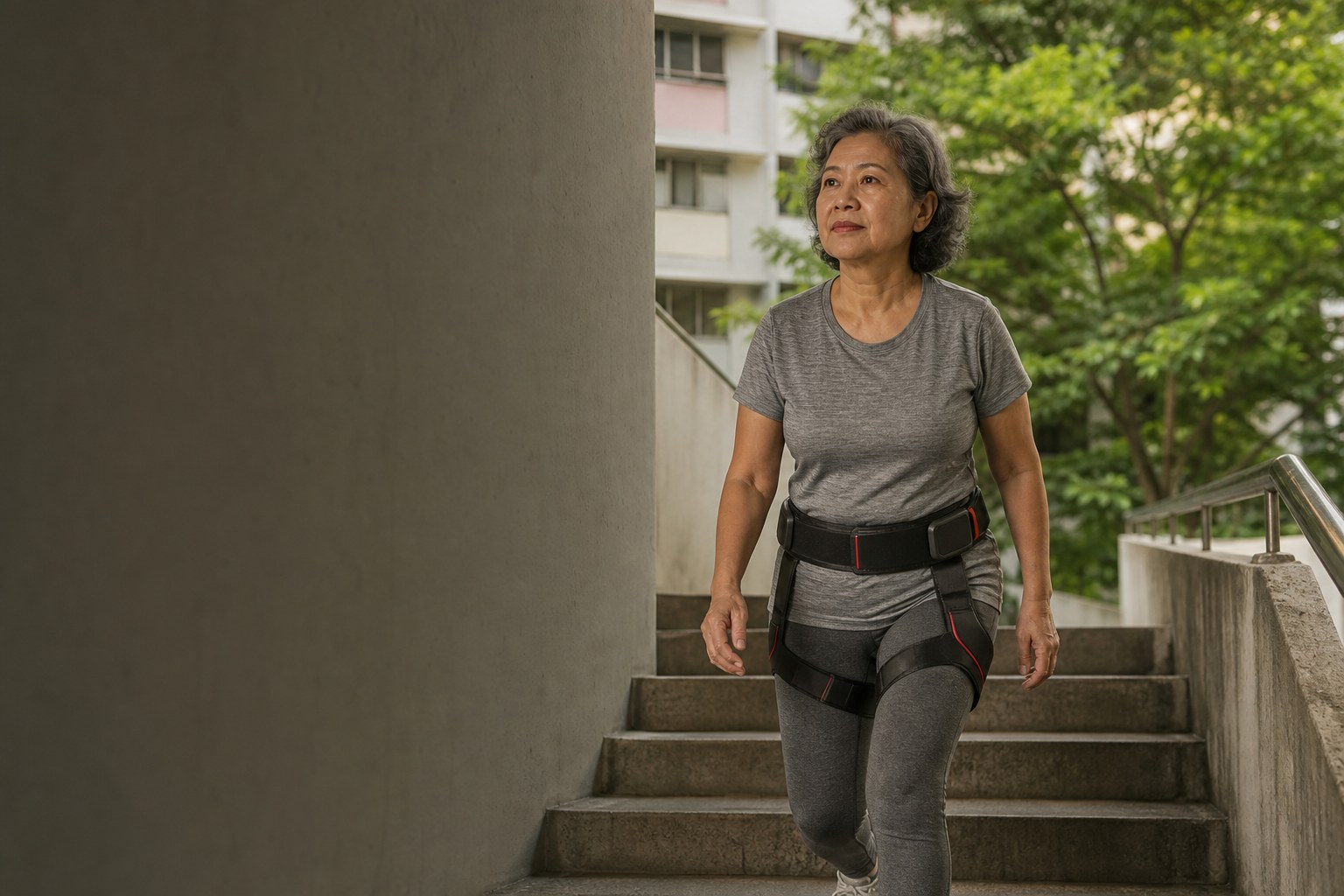
Can I use a powered hip exoskeleton after a hip or knee replacement?
Possibly, but only once your surgeon or physiotherapist has cleared you to bear weight and walk the distances you are aiming for. A powered hip exoskeleton is not part of the early, supervised recovery phase. Where it can help is later: when you are walking independently again but still tire on stairs, slopes or longer routes. It is a consumer mobility-assist device, not a medical device, and it works alongside physiotherapy, never instead of it.
The short version for families
Joint replacement recovery is a clinical process with its own timeline, exercises and restrictions, and those come from the surgical team. Nothing about a consumer exoskeleton changes that. The sensible way to think about a powered hip exoskeleton is as a possible later step: something to consider once the formal recovery work is well under way and walking is safe, but everyday routes still feel harder than they should.
If you only take one thing from this guide, take this: ask the surgeon or physiotherapist before the first try, and bring this page if it helps the conversation.
Why timing matters
In the early weeks after an operation, the priorities are wound healing, managing swelling and pain, protecting the new joint, and relearning a safe walking pattern with whatever aid the team has prescribed. A hip exoskeleton adds torque at the hip as it flexes. For a newly operated hip, that is a load the surgical team needs to agree to. For a newly operated knee, the hip is not the problem joint, but adding a device to the walking pattern while it is still being retrained is still a decision for the team.
Later, the picture changes. Many people reach a point where they are walking without a frame, the exercises are routine, and the remaining problem is stamina: they can do the walk, but it costs more than it used to and they avoid it. That is where an assist device may have a role.
What it can and cannot do for you
What the device does, in plain terms:
- It adds up to 16 Nm of assistance at the hip as you lift each leg (spec-sheet figure).
- It reads your gait and adjusts on its own between level ground, stairs and slopes.
- It pauses when you sit down and resumes when you stand.
- The manufacturer claims up to 80% less lower-body load per step and up to 35% less energy on climbs for this model. Those are manufacturer claims; your own result depends on your body, your route and the assistance level.
What it does not do:
- It does not speed up healing or treat the joint.
- It does not replace the strengthening exercises your physiotherapist prescribes.
- It is not a balance aid. If you still need a stick for stability, keep the stick.
- It does not assist the knee directly. After a knee replacement, any benefit comes from making hip flexion cheaper, not from supporting the knee.
Questions to clear with your surgical team
Take these to your next review. They are written so you can read them out as they are.
- Am I cleared to bear full weight and walk without restriction on distance?
- Are there any movements or ranges I should still avoid at the hip?
- Is there any reason a belt at the pelvis and straps on the outer thigh would be a problem for my wound or skin?
- Would you prefer that some of my walking stays unassisted, for strength?
- Who should I tell if something feels wrong while using it?
If the answer to the first question is not yet, wait. There is no benefit in rushing.

What a sensible first month looks like
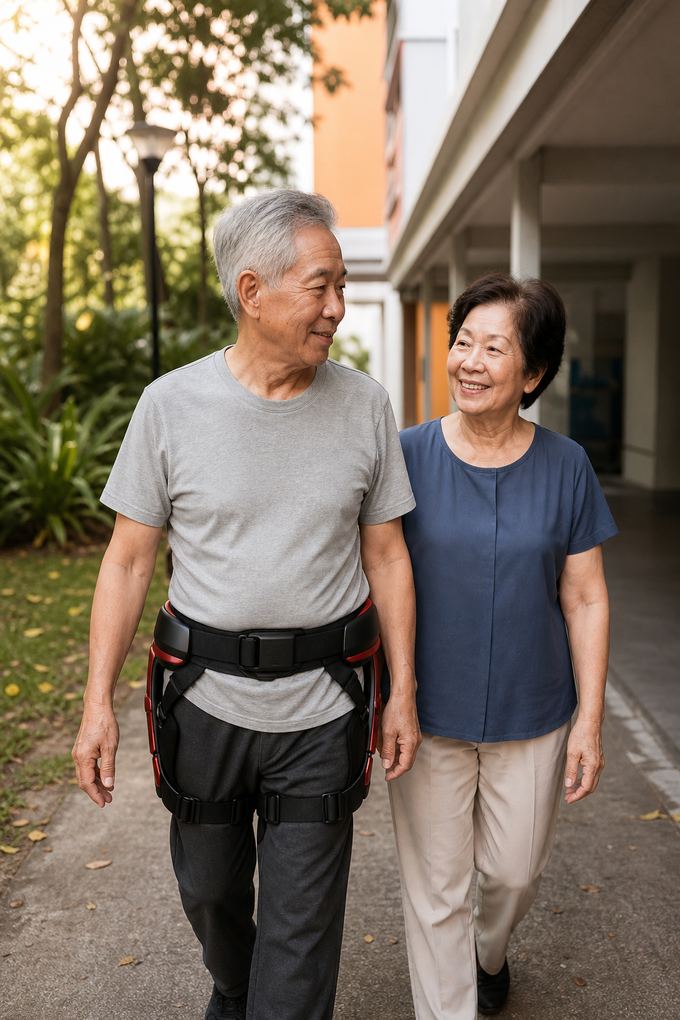
Once you are cleared, the Singapore team can do a guided fitting at home or on your own route. The assistance level is set conservatively at first. A pattern that works for many people:
- Week 1: short level walks indoors or along the corridor, 10 to 15 minutes, to get used to the feel.
- Week 2: one flight of stairs, a ramp or a gentle slope, with the handrail.
- Weeks 3 and 4: the route you most want back, such as the market, the park or the bus stop.
Keep your physiotherapy exercises going throughout. Write down how far you walked and how you felt, so you have something concrete to show at your next review. Our guide to fear of falling and walking confidence covers the other half of recovery that rarely gets discussed: the nerves that stay after the joint has healed.
For the physiotherapist reading this
If a patient hands you this page, the device is a hip-only, powered flexion assist with automatic terrain switching, no balance function, and a peak of 16 Nm. Our guide for physiotherapists covers suitability, exclusions and how to set a measurable target route.